

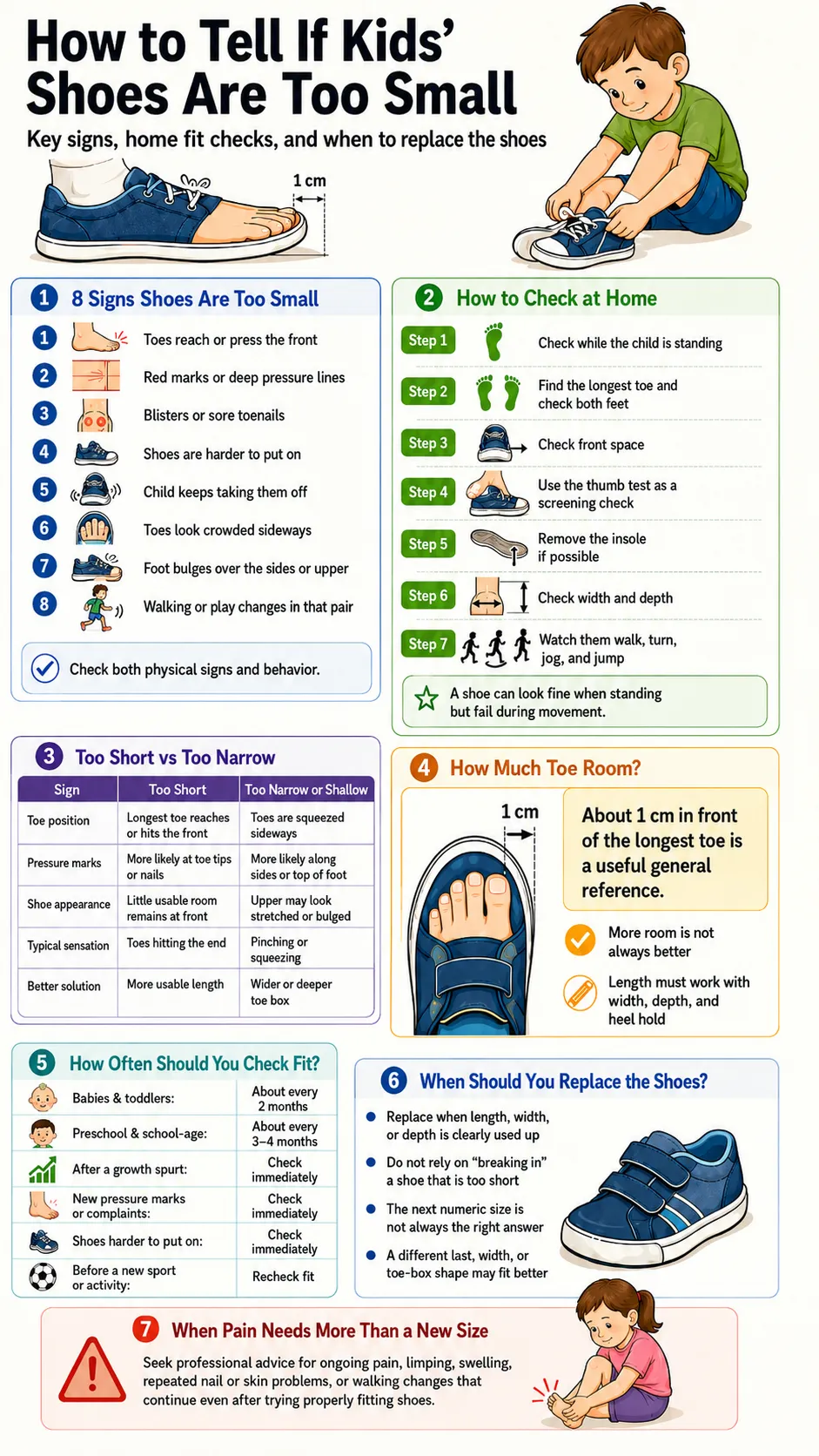
8 Signs Your Child’s Shoes Are Too Small

1. Their Toes Reach or Press Against the Front
Have your child stand naturally in the shoes and locate the longest toe, which is not always the big toe.[4]
If the longest toe reaches or presses against the front, the shoe is too short or close to being outgrown. Curling toes are another sign that usable length is running out.
2. You See Red Marks or Deep Pressure Lines
Take the shoes and socks off after your child has worn them for a while.
Look for repeated pressure marks around the:
- Toe tips
- Little-toe side
- Big-toe joint
- Top of the toes
- Instep
- Heel
Blisters and deep skin pressure are among the signs Stride Rite identifies with poorly fitting or outgrown shoes.[2]
A light sock impression that disappears quickly is different from a concentrated red mark that repeatedly forms in the same area.
3. They Get Blisters or Sore Toenails
Repeated blisters or sore toenails can signal excessive friction or pressure, especially when the toes are being pushed against the front of the shoe. One isolated blister can have other causes, but irritation that keeps returning in the same place warrants a fit check.
4. The Shoes Are Harder to Put On

A pair that used to go on easily but suddenly feels difficult can signal growth. Look for a heel that is harder to insert, an unusually tight opening, straps that no longer close in their usual position, or laces that need much more loosening.
If the change is new, recheck the fit rather than assuming the shoes need more breaking in.
5. They Keep Taking the Shoes Off
Children do not always describe poor fit directly. Younger children may instead avoid a pair, remove it quickly, or describe it as feeling strange or uncomfortable.[3] A sudden dislike of previously comfortable shoes is therefore worth a fit check.
6. Their Toes Look Crowded Sideways
Enough length does not guarantee enough width.
If the toes look compressed after wear, the little toe is pushed inward, or the forefoot appears squeezed, the toe box may be too narrow.
This is why checking only the front gap can miss an important fit problem.
7. The Foot Bulges Over the Sides or Upper
Look at the shoe while your child is standing.
The upper should follow the foot without being stretched tightly across the sides or top. Pressure around the forefoot or instep can mean the shoe lacks width or depth.
Stride Rite specifically recommends checking children’s shoes for length, width, and depth, rather than relying on size alone.[2]
8. They Walk or Play Differently in That Pair
Have your child walk and play normally while wearing the shoes.
Watch for:
- Shorter or cautious steps
- Reluctance to run
- Frequent stopping
- Unusual foot movement
- A sudden preference for another pair
Stride Rite recommends checking fit while children walk, run, jump, and move because problems may become more obvious in motion.[2]
Persistent limping or pain should not automatically be blamed on shoe size.
How to Check at Home If Kids’ Shoes Are Too Small

Step 1. Have Your Child Stand Up
Check the shoes fully fastened while your child is standing. Weight-bearing allows the feet to spread naturally and gives a more realistic picture of the available space than checking while seated.
Step 2. Find the Longest Toe and Check Both Feet
Locate the longest toe rather than automatically using the big toe. For some children, the second or another toe extends farther.[4]
Check both feet as well. Small differences between left and right are common, and Clarks specifically recommends measuring both feet when monitoring children’s growth.[3]
Fit the shoes to the larger foot rather than squeezing it to accommodate the smaller one.
Step 3. Check the Space at the Front
The toes need room to move without the shoe becoming so long that the foot slides around.
FootCareMD recommends at least about 1 cm of space between the toes and the end of a child’s shoe as a fitting reference.[1] Other professional fitting systems use different allowances, so treat this as a practical reference rather than a universal measurement for every shoe.
Length also needs to work with width, depth, heel hold, and the shape of the toe box.
Step 4. Use the Thumb Test as a Screening Check
The thumb test is useful for estimating front space,[1] but it is only a screening check. Children can curl or pull their toes back, and stiff toe boxes can make the longest toe difficult to feel.
Confirm the result with width, depth, and movement checks.
Step 5. Remove the Insole If Possible
If the insole is removable, place it on the floor and have your child stand on it with the heel positioned correctly. The toes and forefoot should remain within its outline rather than reaching or spilling over the edges.[4]
Use this as a visual screening tool, not a complete fit test, because the insole does not show how the upper fits around the foot.
Step 6. Check Width and Depth
Check for squeezing at the little toe, big-toe joint, and instep; width and depth matter as well as length.[2]
If the shoe is tight sideways or over the top of the foot, choose a wider or deeper shape rather than automatically adding length.
Step 7. Watch Them Move
Let your child walk, turn, jog, and jump if the shoe is intended for active use.
The foot should remain secure without obvious heel slipping, toe pressure, or changes in the child’s natural movement.[2]
A shoe can appear acceptable while the child is standing yet cause problems once the foot moves inside it.
Too Short vs Too Narrow: How to Tell the Difference
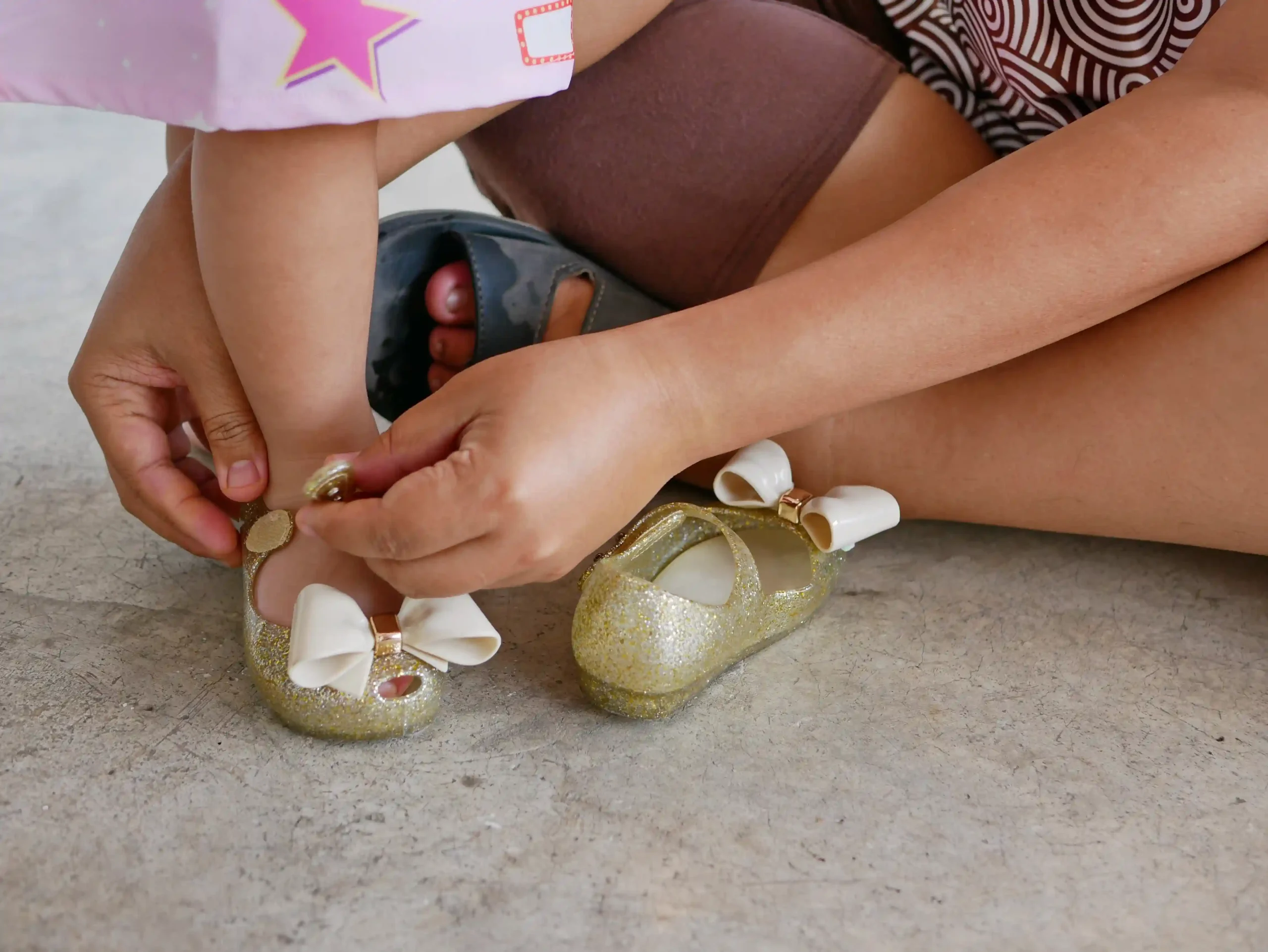
“Too small” does not always mean “too short.”
| Sign | Too Short | Too Narrow or Shallow |
|---|---|---|
| Toe position | Longest toe reaches or hits the front | Toes are squeezed sideways |
| Pressure marks | More likely around toe tips or nails | More likely along sides or top of foot |
| Shoe appearance | Little usable room remains at front | Upper may look stretched or bulged |
| Typical sensation | Toes hitting the end | Pinching or squeezing |
| Main fit problem | Not enough length | Not enough width or depth |
| Better solution | More usable length | Wider/deeper toe box or different last |
If length is adequate but the shoe is too narrow or shallow, adding a full size can create excess toe room and heel movement without fixing the underlying shape mismatch.
How Much Toe Room Should Kids’ Shoes Have?
FootCareMD recommends at least about 1 cm of room in front of a child’s toes as a fitting reference.[1] The exact usable space still depends on toe-box shape, construction, foot shape, and heel hold.
More is not automatically better. Excessive growing room can let the foot slide and reduce heel security, while adequate length does not compensate for a shoe that is too narrow or shallow.
Fit tip: Measure from the longest toe and check both feet.
How Often Should You Check Kids’ Shoe Fit?
Children’s feet do not follow a fixed growth schedule, so regular checks are more reliable than trying to predict the next size change.
| Child or Situation | Practical Approach |
|---|---|
| Babies and toddlers | About every 2 months |
| Preschool and school-age children | About every 3–4 months |
| After a noticeable growth spurt | Check immediately |
| New pressure marks or complaints | Check immediately |
| Shoes become harder to put on | Check immediately |
| Before starting a new sport or activity | Recheck fit |
Stride Rite recommends frequent measurement for babies and toddlers,[2] while FootCareMD recommends checking children’s shoe fit about every three to four months.[1] Growth varies between children and is generally faster in the earliest years.[3]
When Should You Replace the Shoes?

Replace or refit the shoes when the child has clearly used up the available length, width, or depth.
Do not try to “break in” a pair that is too short: the upper may soften, but the shoe will not gain meaningful internal length.
The correct replacement is not always the next numerical size. If length is adequate but width or depth is the problem, a different last, toe-box shape, or width may fit better.
When Foot Pain Needs More Than a New Shoe Size
Poor fit can cause rubbing, pressure, and discomfort, but persistent symptoms should not automatically be blamed on shoe size.
Seek advice from a pediatrician, podiatrist, or other qualified healthcare professional for ongoing pain, limping, swelling, recurrent nail or skin problems, or a persistent change in walking—even after changing to properly fitting shoes.
FAQs
How can I tell if my toddler’s shoes are too small?
Look at physical signs and behavior together. Toe pressure, red marks, crowded toes, shoes becoming difficult to put on, repeated shoe removal, or reluctance to walk in a particular pair can all justify checking the fit.
Should kids’ toes touch the end of their shoes?
No. The longest toe should have usable space ahead of it rather than pressing against the end during normal standing and movement. FootCareMD recommends at least about 1 cm as a general fitting reference.[1]
How much room should be in the front of kids’ shoes?
About 1 cm is a useful general reference from FootCareMD, but fitting systems and shoe designs differ.[1] Check the actual shoe for length, width, depth, heel security, and comfortable movement rather than relying on one measurement alone.
Should I buy kids’ shoes one size bigger?
Not automatically. Sizing varies between brands and styles, and a longer shoe does not necessarily solve a width problem. Measure both feet and judge the internal fit of the actual shoe instead of adding a fixed size for growth.
Can tight shoes stretch enough for a growing child?
Some leather and textile uppers become softer with wear and may give slightly across pressure areas, but they do not gain meaningful length. A shoe that is genuinely too short needs to be replaced rather than stretched for continued growth.
Conclusion
To tell if kids’ shoes are too small, check length, width, depth, pressure points, and how your child moves—not just the gap in front of the toes. Regular checks can catch an outgrown pair before discomfort becomes obvious.
At Bebenelle, we develop children’s footwear across different lasts, widths, materials, and age groups, with fit and everyday wear in mind. Explore our kids’ footwear or contact us to discuss a custom shoe project.
Sources
[1] FootCareMD / American Orthopaedic Foot & Ankle Society — Back-to-School Shoe Guide
[2] Stride Rite — Kids’ Shoe Fit Guide
[3] Clarks — How Fast Do Children’s Feet Grow? A Parent’s Guide, April 27, 2026.
[4] Fitting Children’s Shoes — How to Tell If Your Kids’ Shoes Fit — Find Out From Home, August 17, 2025.
 English
 Arabic
 German
 Spanish
 French
 Italian
 Japanese
 Korean
 Portuguese
 Russian
